


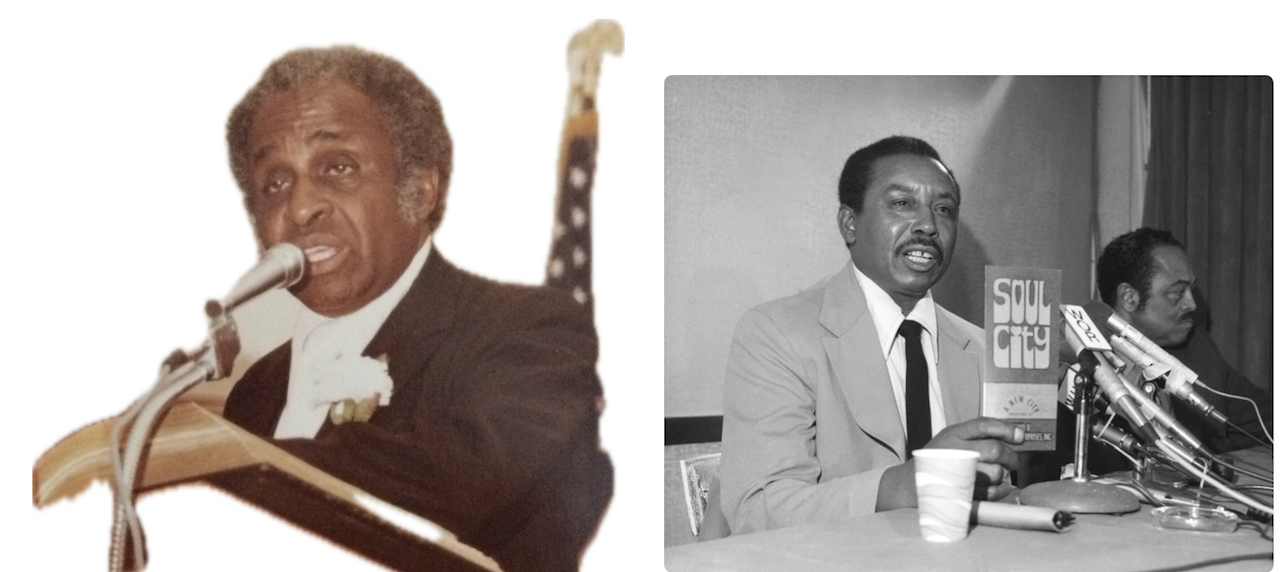
North Carolina highway historical markers honoring Rev. Dr. Grady D. Davis Sr. of Northampton County and Floyd B. McKissick Sr. of Warren County were unanimously approved by the North Carolina Highway Historical Marker Committee.
“These markers ensure that the people and movements who reshaped our democracy are remembered not only in textbooks, but in the very communities where history was made,” Rodney Pierce, a local educator and historian who also serves as House District 27 representative, said. “Dr. Davis and Judge McKissick devoted their lives to justice, education, and public service. It is an honor to help permanently recognize their legacies.”
Davis
Davis was a nationally respected pastor, educator, and civil rights leader whose work bridged faith, scholarship, and social action.
Davis earned degrees from Shaw University, Andover Newton Theological Seminary, and Boston University, where he studied alongside Dr. Martin Luther King Jr. He marched with King during the 1965 Selma to Montgomery March and was jailed for his role in the movement.
In 1985, his return to Selma was documented by WRAL-TV, where he was presented with the key to the city.
“Grady Davis Sr. will be honored with a historical marker in his hometown of Pleasant Hill,” said Leslie Leonard, the research historian supervisor and administrator of the state’s Highway Historical Marker Program. “This marker recognizes his vital role as a civil rights advocate and his service as a state parole commissioner.”
Dr. Deryl Davis-Fulmer, Davis’s daughter, said her father devoted his life to serving others and defending the rights citizens are privileged to currently enjoy.
“His courage, his conviction, and his unwavering commitment to justice shaped generations,” she said. “Having him as my father has been the greatest honor of my life. I am profoundly proud of his sacrifices, his legacy, and the privilege of carrying the Davis name.”
An influential educator, Davis taught at Shaw University, East Carolina University, and Fayetteville Technical Community College, and served as dean of Shaw Divinity School, later becoming professor emeritus. He pastored Oberlin Baptist Church in Raleigh and Union Baptist Church in Durham, where he led mass meetings and civil rights organizing.
A World War II veteran, former North Carolina Parole Commissioner, and lifelong advocate for education and youth justice, Davis was honored statewide when Governor James B.
Hunt proclaimed “Dr. Grady Davis Day” in 1981. Following his death, he was recognized on
the floor of the U.S. House of Representatives as a “leader and history maker.”
McKissick
McKissick was one of the most consequential civil rights leaders, lawyers, and public servants of the 20th century.
Born in Asheville, McKissick broke racial barriers as the plaintiff in McKissick v. Carmichael (1949), which led to the desegregation of the University of North Carolina-Chapel Hill School of Law.
A prominent civil rights attorney, he later served as National Director of the Congress of Racial Equality (CORE) from 1966 to 1968 and worked closely with the NAACP, including speaking at the 1963 March on Washington.
In the 1970s, McKissick founded Soul City in Warren County — the only federally funded, Black-led model city supported by the U.S. Department of Housing and Urban Development – envisioned as a center for economic self-determination and racial equity.
“McKissick will be honored with a historical marker in Soul City, North Carolina, the visionary community he founded,” said Leonard. “This recognition commemorates his pivotal contributions to civil rights and his enduring impact on North Carolina’s history.”
In 1990, McKissick was appointed a District Court Judge for North Carolina’s Ninth Judicial District. A World War II veteran awarded the Purple Heart and five battle stars, McKissick also taught law, served as dean emeritus at Shaw Divinity School, pastored First Baptist Church of Soul City, and authored influential works on civil rights strategy and Black empowerment.
“We are pleased and honored that the historical marker will be in Warren County where my father and mother (Evelyn) lived their lives with courage and conviction, which is engraved on their mausoleum near the family home in Soul City,” said McKissick’s daughter Dr. Charmaine McKissick-Melton.
The McKissick and Davis families are connected as McKissick-Melton, Davis-Fulmer, and their respective siblings desegregated North Durham Elementary School.
Since 2018, Pierce has successfully applied for 11 North Carolina highway historical markers.