


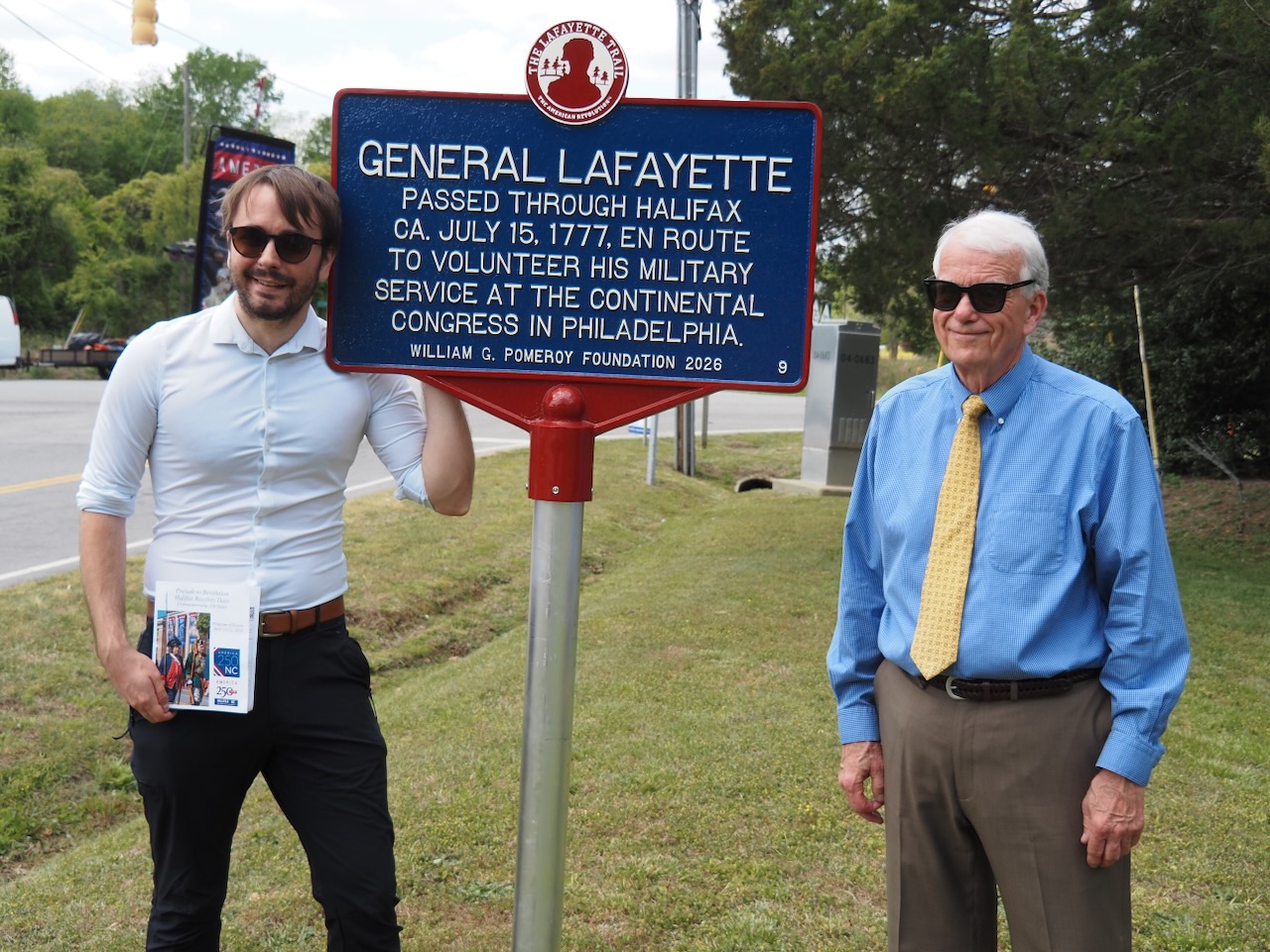
A new marker unveiled Sunday marks Halifax as part of the Lafayette Trail, commemorating his passing through the town around July 15, 1777.
The marker acknowledges that the general was on his way to volunteer his military service at the Continental Congress in Philadelphia.
The marker is across the street from a Dollar General store on property owned by the Historical Halifax Restoration Association, said Larry Armstrong, chair of the organization. “This is one of the first stops on the National Lafayette Revolutionary Trail.”
Julien Icher, president of the Lafayette Trail, said the organization is a nonprofit that celebrates the legacy of Lafayette through a variety of mediums, “the most famous one of which is the installation of historical markers.”


As of Sunday, there have been over 210 markers approved for the program that celebrates his farewell tour, which was celebrated in Halifax and Enfield last year. The marker unveiled Sunday is part of a new program launched celebrating Lafayette’s participation in the American Revolution called Lafayette 250.
“The reason we’re doing it today is because we wanted to tie it in with the Halifax Resolves anniversary for different reasons," Icher said. "The main one is I think it serves to tell the story that what Lafayette wanted to accomplish here was to secure American independence.”
Icher said Lafayette sympathized with the struggles Americans had and the objectives they were trying to achieve during the war. “We thought it was a great way to celebrate the ideological affinity uniting the American people fighting for their natural right to self-determination and Lafayette’s own pursuit of such ideals.”
The William G. Pomeroy Foundation helps to fund the markers across half of the United States, he said. Documentation of the brief visit came in the form of a letter from Major Jean Baptiste Ashe to Governor Richard Caswell. “That letter mentions that Lafayette visited a few days before July 18, 1777. Based on the document, we were able to pursue the donation of our second Lafayette Trail marker in Halifax,” Icher said.
The first marker commemorates Lafayette’s visit to Mary Montfort, the widow of Willie Jones, in 1825.
While Lafayette in the Ashe letter was referred to as the Marquis de Lafayette, Icher said, “It’s always been essential to me to emphasize how Americans responded to Lafayette’s noble bona fides. He was an aristocratic Frenchman that provided a validation of the American Revolution to the fighters here. I think Americans responded very quickly in accepting this aristocratic status and celebrating it because it gave them something they were craving for — which was a validation of their fight by one of the most prestigious, noble aristocratic families of France.”
That the marker identifies him as a general and not a marquis is significant, he said. “He wanted to be called a general in commemoration of his choice to fight for freedom instead of celebrating a birthright freedom.”
Lafayette had arrived in South Carolina and was going to Philadelphia to meet George Washington “to start his American story of service, of selflessness,” Icher said.