


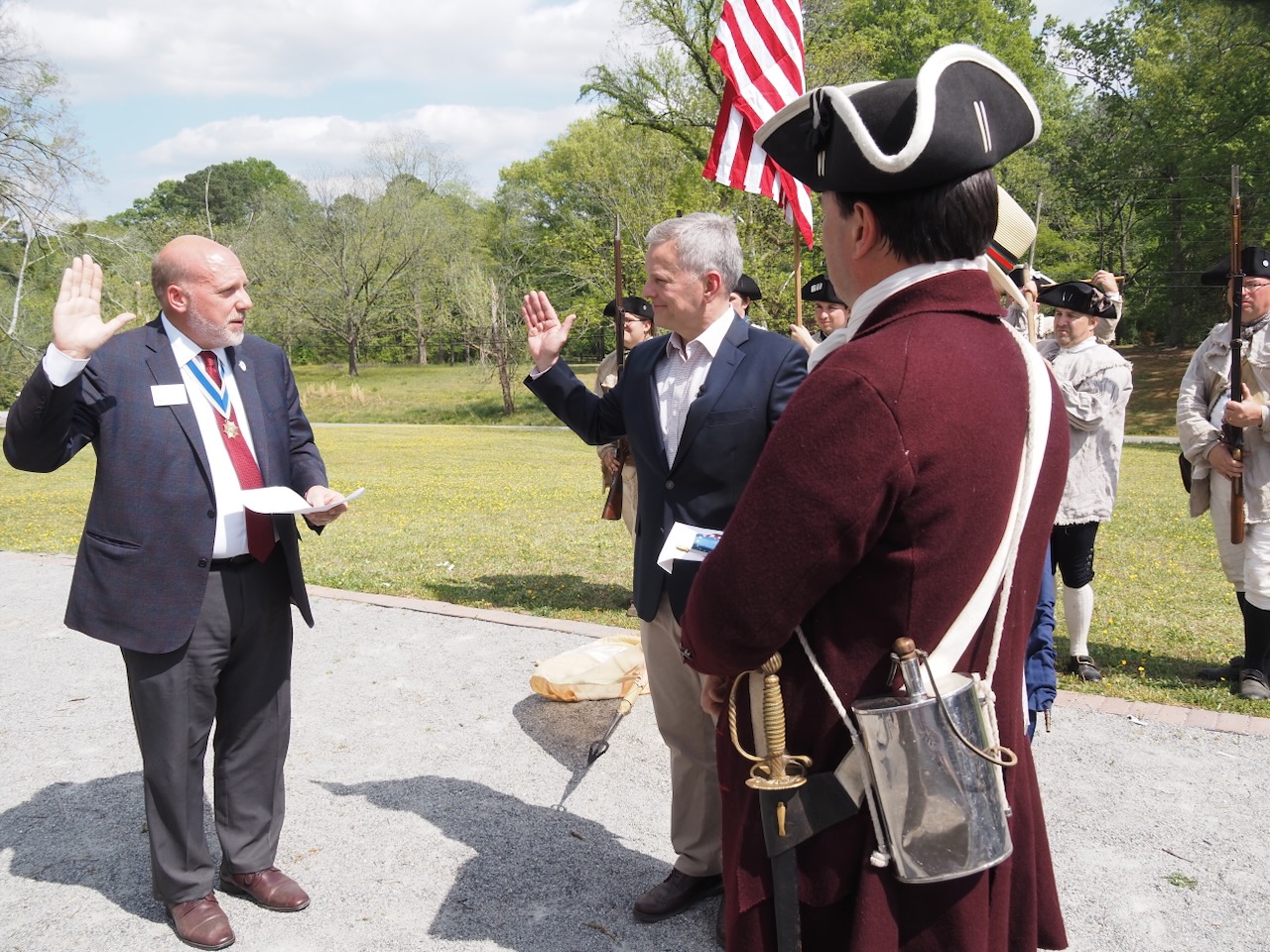
The Halifax Resolves Chapter of the Sons of the American Revolution held its annual wreath-laying ceremony during Sunday’s Resolves Day observances.
The event included speakers and the unveiling of a new marker located beside one erected in 1950 which marks the spot of the first courthouse in Halifax where the Fourth Provincial Congress met from April 4 through May 15, 1776 and adopted the Halifax Resolves on April 12 of that year.
The original marker was erected by the N.C. State Highway and Public Works Commission and the N.C. Society for Preservation of Antiquities.
The new marker explains the original marker was relocated and rededicated by the Resolves Chapter on the semiquincentennial of the adoption of the Resolves.


The SAR also inducted Governor Josh Stein into the society shortly before he gave his keynote address during the annual program held by the Halifax Historical Restoration Association.
The governor’s ties to the American Revolution are through Aaron Willson who was born in 1758 in Petersham, Massachusetts — per his pension deposition — though some accounts place his birth in Winchester, New Hampshire.
In 1775, the year of the Battle of Bunker Hill, he excavated a canal on West Street in Keene, reflecting his early involvement in local civic labor. The following year, in June 1776, he enlisted for five months as a private in Captain James Wetherbe’s Company in Colonel Isaac Wyman’s Regiment of New Hampshire militia. He marched to Ticonderoga and was stationed on Mount Independence, where he served the full term of his enlistment and was discharged about early December, completing approximately five months and five days of service.
In 1777, during the Burgoyne campaign, an express call for men prompted him to volunteer for an alarm expedition. He served under Major Davis Howlett of Keene, and under a colonel identified in the record as either Ellis or Ashley. The detachment marched as far as Rutland, Vermont, and several miles beyond before being ordered to return home, having been absent for about 10 days. Later that same year, he again responded to an alarm following the burning of Royalton, Vermont. He rendezvoused at Charlestown, New Hampshire, and served under Major Howlett for approximately 22 days. Throughout these services, he stated that he volunteered and marched from Keene.
He later applied for and received a pension under the Act of 7 June 1832, based on his Revolutionary War service, with his declaration made in June 1833 in Cheshire County, New Hampshire. Supporting testimony was provided by Samuel Bassett of Keene, who had known him for about sixty years and recalled his service, and by John S. Blake, who served alongside him in 1776 at Mount Independence.