


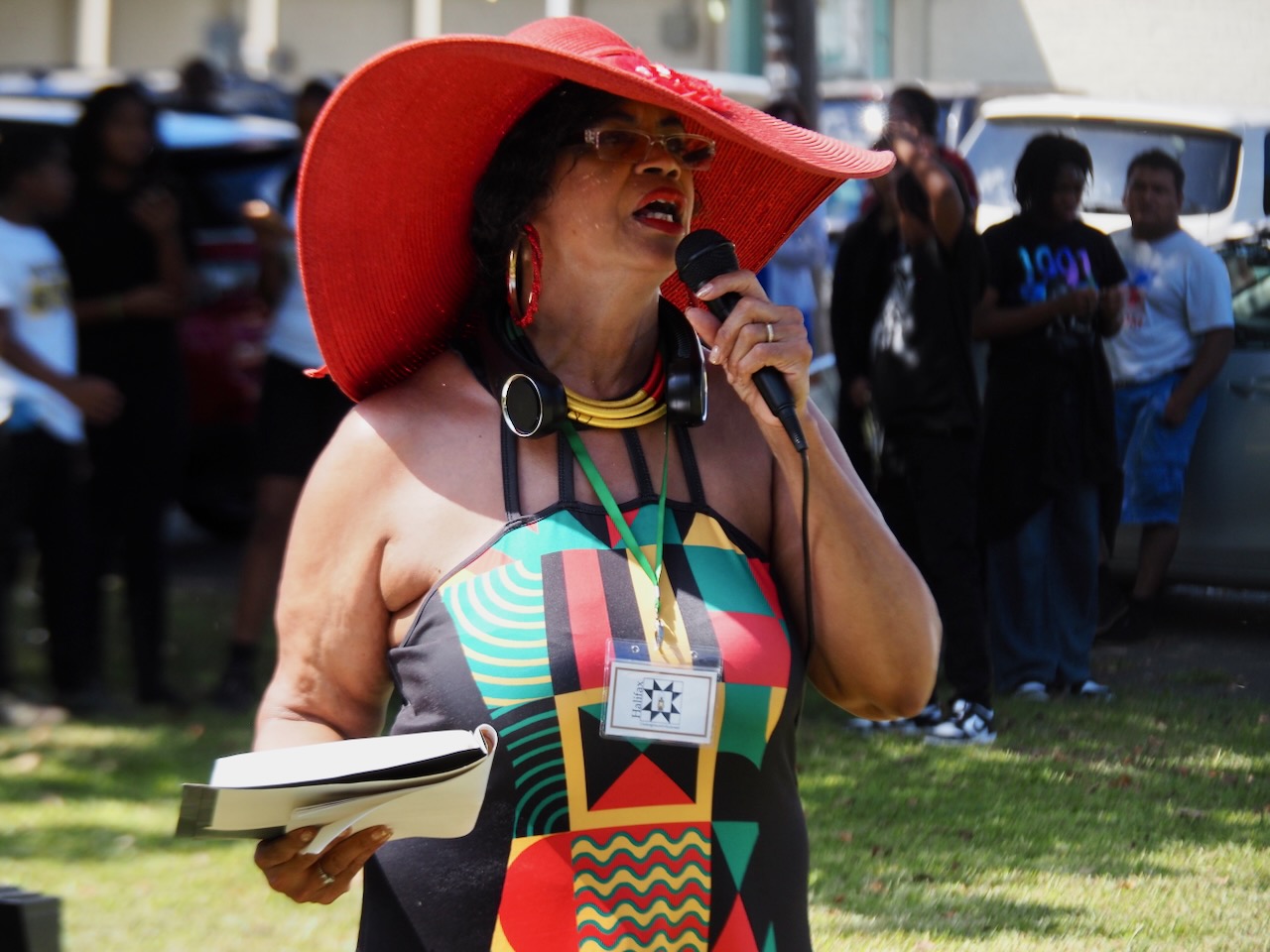
Jackie Ruffin Pittman, after singing the spiritual Wade in the Water, told the audience at Saturday’s Halifax County Underground Railroad Day celebration in Weldon that there was a reason she chose that song.
“That song was sung because people had to get in that water, and they had to find their freedom through water many a time,” said Pittman, a reenactor who portrays a cook named Piety who worked for the Roanoke Navigation Company.
Reciting a poem as her opening address, she said, “I wanted to share this as my welcome to you—to just be free, as the name of this I’ve written.”
The poem recounts how an enslaved man from Virginia ran to the Roanoke River as the waters pulled him down. “He almost drowned. Yet he rose again, step by step towards Halifax.”
A woman from Northampton County walked all night—her faithful dog, her only guide. “Together, they sought the morning light where hope, not chains, could reside.”
Then, reciting the poem, she read, “Another man, dressed sharp and tall, walked the road with steady pace—freedom’s whisper was worth it all. He would not die in a bound man’s place.”


Nancy Muller, a member of the Halifax Underground Railroad Committee, said she became involved early because it’s history and it’s interesting. “The town of Halifax had the largest population of free Black people in the state, so when people who were running from slavery arrived there, it may have been the first time in their lives they could walk around the streets just as a person—not somebody who’s going to be asked for their papers, ‘who do you belong to,’ and ‘what plantation are you from’—but just a person.”
Halifax, she said, “had a large, free Black population, and that is why it was an important part of the Underground Railroad in this area.”
There was also a Quaker community that helped them on their journey north. “For me, the emotion of being able to walk around for even a few minutes just holding your head up and not being asked who you belong to—that’s the feeling behind my interest.”
Muller said the Underground Railroad is part of this country’s history—history she fears “is being whitewashed. But it’s something that we all need to know.”
Sandra Bryant, who chairs the committee, told the audience that in 1860, according to the census, there were approximately 4 million enslaved Black people living in the country, up from 700,000 in 1790. “So in less than 100 years, that shows how much slavery increased,” she said. “Locally, we are celebrating the Halifax County Underground Railroad.”
The population of the county at that time was 20,442 people. Of that total population, 6,641 were white, 10,349 were enslaved, and 2,452 were free Black people. “Because Halifax County had one of the largest free Black populations at that time, enslaved people, when they left Greensboro, Charlotte, Raleigh, and other areas would come to Halifax because they could blend in with that large free Black population and they knew they would have someone who would be able to provide shelter and food for them and hopefully share information of how they could leave and go further north to seek freedom.”
Halifax County Board of Commissioners Chairman Vernon Bryant read a resolution proclaiming Saturday as Halifax Underground Railroad Day.
The Heritage Quilters of Warren County offered a quilt as a raffle, and the audience heard selections from the Weldon Middle School-High School Band.
Earlier in the celebration, which was held in Weldon, Sandra Bryant took guests on a tour of River Falls Park, which is one of the designated Underground Railroad sites in the county. The other sites designated by the National Parks Service include Historic Halifax and the Roanoke Canal.
The committee, she said, is raising funds for a monument and, in the future, a museum honoring the county’s links to the Underground Railroad.
There are conceptual drawings for a museum completed, she said, but due to funding threats nationally, she said the group is currently considering doing a monument first. “We have a couple of drawings that have been submitted by an artist.”
A presentation of the drawings will be submitted to the committee next month. “We feel like that might be easier for us to start with. We really have to have a place where people can come and reflect on the history.”
With the emphasis that has been placed on the role the Underground Railroad played in the county, more people are learning about that history, she said. “I think a lot of people were like me and had never heard of it.”