


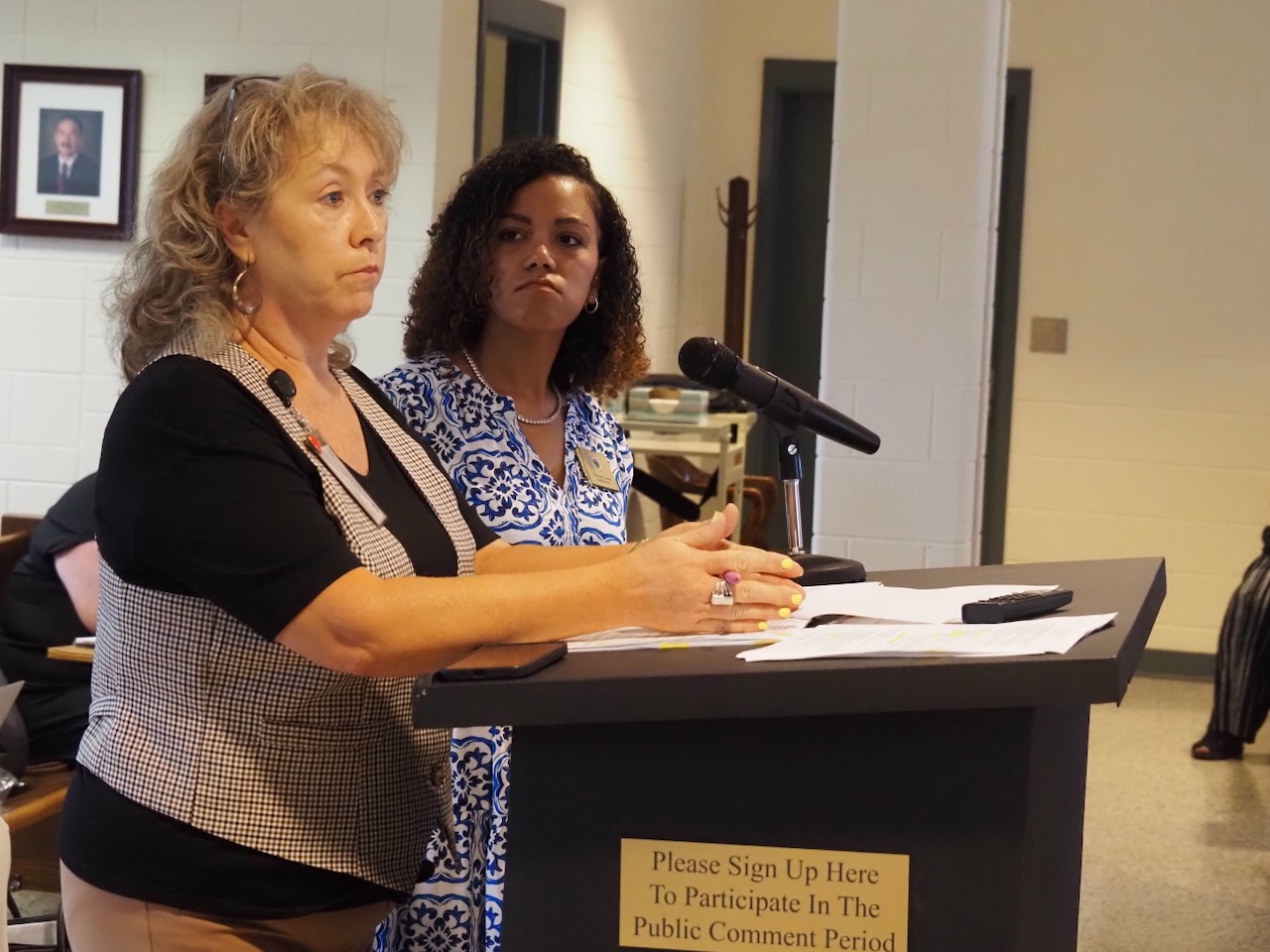
A reconciliation of 15 years of county audit books done by Halifax County Health Director Cheyanna A. James and Assistant Health Director Betty Reese identified a total of $6,013,570 of budget amendments that went from the health department back to the county’s general fund, James and Reese told commissioners Monday.
The investigation of books began with the 2008-09 fiscal year and the examination included the county audit books and the Munis accounting system, Reese said. In the 2007-08 fiscal the health department started with $1 million.
(See related story at this link)
Fiscal year 2013-14 is when the health department closed its outlying clinics in Enfield and Scotland Neck and was the first she said money in the amount of $397,000 was taken from the health department. Then in fiscal year 2016-17, $1,117,000 was taken. “The way our state expenditure report works, is any time we report expenditures to the state we have to tell them who paid for this money — whether it was state money, whether it was local money.”
Since the state has closed those books on the 13-14 and 16-17 fiscal years, the state considers that money already reported to them and the books have been closed. “That’s a concern for me,” Reese said. “That’s one of the reasons we wanted to keep this at home because if the state goes back and audits these books, they will see we reported these monies as being spent.”


The COVID factor
In fiscal years 19-20 through 22-23, the health department had approximately $1.5 million in COVID money. “Out of our county appropriation we also spent an additional $350,000 of county allocations that was given to us as a normal county allocation because we didn’t get enough from the state.”
In the 22-23 fiscal year, finance made an entry for $2 million while receiving $2.8 million. “If you take that $2 million out of that $2.8 million, that left us with a net amount of county allocations of $821,000,” Reese said. “When you add the adjustments back in — which was money taken from us — we have earned approximately $13,498,000.”
Out of that, she said, approximately $6 million has been taken from the health department. “I do not think there’s any maliciousness in this.”
Referring to money taken in 1999 by former County Manager Charles Archer and an attempt by former County Manager Matthew Delk to do the same, the state informed them that the money was taken or attempted to be taken in error and could result in funding issues for the health department, Reese said.
She said if the $2.25 million taken in the 2024-25 fiscal year when the department received $2.8 million in county funds, would leave the department with a net county allocation of $360,000.
Accounting methodology
What the issue comes down to is a change in accounting methodology, Reese said.
What the health department learned was that the methodology being used was at best inaccurate. Once the methodology was modified the department realized it had been profitable for the last several years.
In the 19-20 fiscal year with the initial methodology the health department earned $90,000. “The new methodology shows that we earned $1.3 million. If you look at fiscal year ‘21 it shows we used $652,000 of our fund balance. The new methodology shows we earned $356,000.”
In fiscal year 2021-22 the health department used fund balance of $261,000 while the county shows the department earned a million dollars and in fiscal year 2022-23 health department records show it used $547,000 while county finance shows the department earned $1 million. “Our mindset was that we were losing money — we were bleeding. Every health director has confirmed they thought we were losing money for years so we didn’t know we had a surplus. Not one time were we told that we were making money. We never knew that until the last couple of months.”
The question of how then department is making money is one that has arisen, Reese said. “We get reimbursed on costs.”
Then there is billing for services because some people could come in for multiple services. “Just because you count me as one patient, doesn’t mean I’m not there for multiple services.”
Doing more with less
Then, James said, the health department is doing the same work with about half the staff it once had — a number that Reese said was once at 143 but now is at 60. Forty of those were from home health and hospice and then the health department lost 29 clinical staff members.
But, Reese said, “We’re still providing the same services. A lot of our staff are doing more with less.”
The second thing, she said, is the methodology where the health department gets reimbursed based on what it costs to provide the services.
County attorney interjection
At that point County Attorney Glynn Rollins interjected, “When you say you get reimbursed you’re talking about Medicaid,” to which Reese said yes.
Rollins continued, “Isn’t it true that you would not have Medicaid reimbursements unless you had a fee schedule?”
Reese affirmed the department has a fee schedule based on Medicaid to which Rollins responded, “What we’re talking about here is whether you have $6 million in earned fees.”
Rollins questioned if fees make up 2 percent of the budget how could the department have an excess of $13 million. “You don’t get to keep the county appropriations that we give you each year. That’s not money earned.”
Reese said out of the current $7 million budget, the department has received $114,000 in fees from patients to which Rollins countered, “What’s happening here you’re so-called making money because you’re including in that what was paid for out of county appropriations.”
He said that the state department of Health and Human Services told the department to spend the county dollars but don’t spend the fee earnings “because you get to keep that.”
A long line of health directors were under the impression the health department was losing money, a former county manager never knew the county was taking money from the health department, Reese said. “He also gave us a percentage increase because he was convinced, just as we were, that we were losing fund balance and our fund balance was going away.”
Public health under scrutiny
The news of the matter comes as public health “is under scrutiny and fire from the federal government,” James said as “it pertains to funding to support services we provide to Halifax County. The cuts to Medicaid and SNAP will cripple our community here. We have to find innovative ways to still meet the needs of our community.”
The Women, Infants, and Children program brings over a million dollars to grocery stores in the county “with those services we will lean on heavily once SNAP is officially cut,” James said. “We’re also in a time where measles response is a big driver of our communicable disease response. We know that when COVID happened we were not adequately prepared to respond — financially and staff-wise.”
James said the department has to have money to support staff for overtime, supplies, vaccines, and potential staff that may be needed for contact tracing if the county enters an outbreak status, which she said is likely considering the immunization rate for children is at 92 percent. “We need to be at 95 percent to prevent an outbreak in Halifax County.”
With the $6 million the health department is requesting to be given back it could serve approximately 6,000 children for nine years, she said. “We would like to reestablish an outlying clinic so that we can broaden our reach, and address transportation to care.”
The department would like to use the WIC office at the Neighborhood Resource Center on Jackson Street in Roanoke Rapids as an outlying clinic, James said.
James said of the lengthy discussion of the matter: “It all goes back to that general statute that protects the money in which we earn for the programs in which they’re designed to ensure continuity.”
County attorney comments
Rollins said, “No department in county government has a fund balance. It’s a nice term to use. All it means is this money (the finance department) in her account of all the other county money is for the departments.”
As far as the statute the health department used in justifying the return of the money, Rollins said, “Actually what it says is that money earned from fees is to be used for health department services. It doesn’t say it’s protected. It says it’s to be used to deliver public health services.”
What’s not protected, the county attorney said, are county appropriations made every year to the health department and every other department in county government. “At the end of the year, if you haven’t spent that money, it comes back into the general fund unless that department has asked you for a carryover and you specifically approve it.”
Rollins said, “It’s not that the health department is earning fees that exceed their expenses to the tune of $13.5 million — what is included in that $13.5 million are all the county appropriations that have been supplanted by these fees.”
In others words, he said, “If you go back — and you’re going to have to do this by the way because there’s no way you can just accept these numbers on their face — you’re going to have to go back for each year and see what fees were actually earned (under the general statute) and then determine how much those services cost.”
Once it is known how much fees are earned, the next question is did they exceed the cost of services. “Then if you have something left over that’s what gets held in reserve for public health purposes — not the money the county puts in every year.”
He said he understands the state says spend the county money first “because whatever’s left over is protected from the county taking it back.”
However, he said, “That’s not how you run county government. It’s not fiscally sound to do that and it’s not fair to the rest of the taxpayers of the county. If you’re earning fees that are sufficient to cover costs, then if there aren't general appropriations that are needed then it should come back.”
Webb and Rollins comments
Commissioner Sammy Webb told the board that between there being a discrepancy with the health department one way and the county saying it’s doing this way “there’s a segment of our population who we have failed. That’s the issue. How do we right that wrong when we have failed them for all these years and we closed clinics because you didn’t it (the department) had any money?”
Webb said, “You’re letting staff go because you didn’t think it (the department) has any money. You’re working three jobs because you don’t think you had any money. That’s the issue. How do we correct the wrong that we as a county have done it? How do we move forward from that?”
But Rollins said he didn’t think that was the issue. “I think the issue is that you’ve got balances every year. It means either one of two things — the county is appropriating too much money to the health department or your fee income is a lot higher in which case maybe your fees are too high. I don't know which — but in any case whatever money is left that is your cash on hand for the health department is county money that can be used by the county to fund next year’s budget for the health department.
“If you want to change, that’s your fiscal policy on how to do that. That money isn’t just there for the health department to do whatever they want to … The state anticipates that you’re going to manage your county funds in a fiscally proper way.”
A consolidated agreement between the county and the health department specifically says that locally appropriated funds can’t be withdrawn because there have been more fees earned than you thought there were going to be, Rollins said. “It can’t be withdrawn until the last two months of the fiscal year at which time you do your budget closeout.”
Barrett, Davis, Silver comments
Commissioner Thomas Barrett said the taxpayers of Halifax County have contributed $32,214,418 to the health department. “I think we tried to do our best to make sure you got money. You don’t have profits. The county is subsidizing you.”
Barrett said he understood where the health department is coming from, but added, “I think if there’s something you need from us you need to come to us and be like we want to reopen this place in Scotland Neck. This is what it’s going to cost. Can you guys help us out?”
Barrett believes the county taxpayers made a good faith effort to fund the health department and that the county doesn’t have $6 million to give. “I’m not going to ask the taxpayers in this county to come up with $6 million, but going forward everything you guys need please come and ask us.”
Commissioner Chenoa Davis said going back 20 years before the problem was discovered is unfair to the taxpayers. Going forward, she said, “It seems like there has been collaboration between our county financial director and county manager about establishing a new methodology that you all have agreed to. Now we’re able to see on both ends what is earned from fees and what the county is giving you.”
Commissioner Jimmie Silver said he believed the matter needed to be tabled for further discussion. “You guys need to determine those figures because it may not be $6 million, it may be $1 million but until we clear it I think we would be doing the citizens a disadvantage and the health department a disadvantage.”
Webb asked for a list of prioritized immediate needs to provide citizens with what they are obligated to fund, “especially in these areas where those clinics were closed, what the numbers of workers it would take, and what the cost would be.”
James said after the matter was tabled, “I’m happy that they are taking it into further consideration because it is taxpayer dollars. But we also have a responsibility to the community as the health department and want to ensure that we’re able to provide them services for a long period of time — just not now.”